Managed integration services for ecommerce
Integration-as-a-Service is the full-service AIS program: we build the connections, we monitor them after go-live, we maintain them through platform updates and channel changes, and we own the result against contractual SLAs. One subscription. One accountable team. One integration layer that gets better with use rather than worse.

Never pull your IT team into integration firefighting again.
Most integration engagements are sold as projects. Build the connection, hand it over, walk away. The integration layer ends up in the same place it always does—owned by whoever’s on call when it fails, drifting between releases of the systems it connects, accumulating exceptions nobody documented. Pivotree’s Agentic Integration Services (AIS) is the alternative: the team that builds the integration stays on the integration. We’re accountable for the result for as long as we work together.

There is a
fourth option.
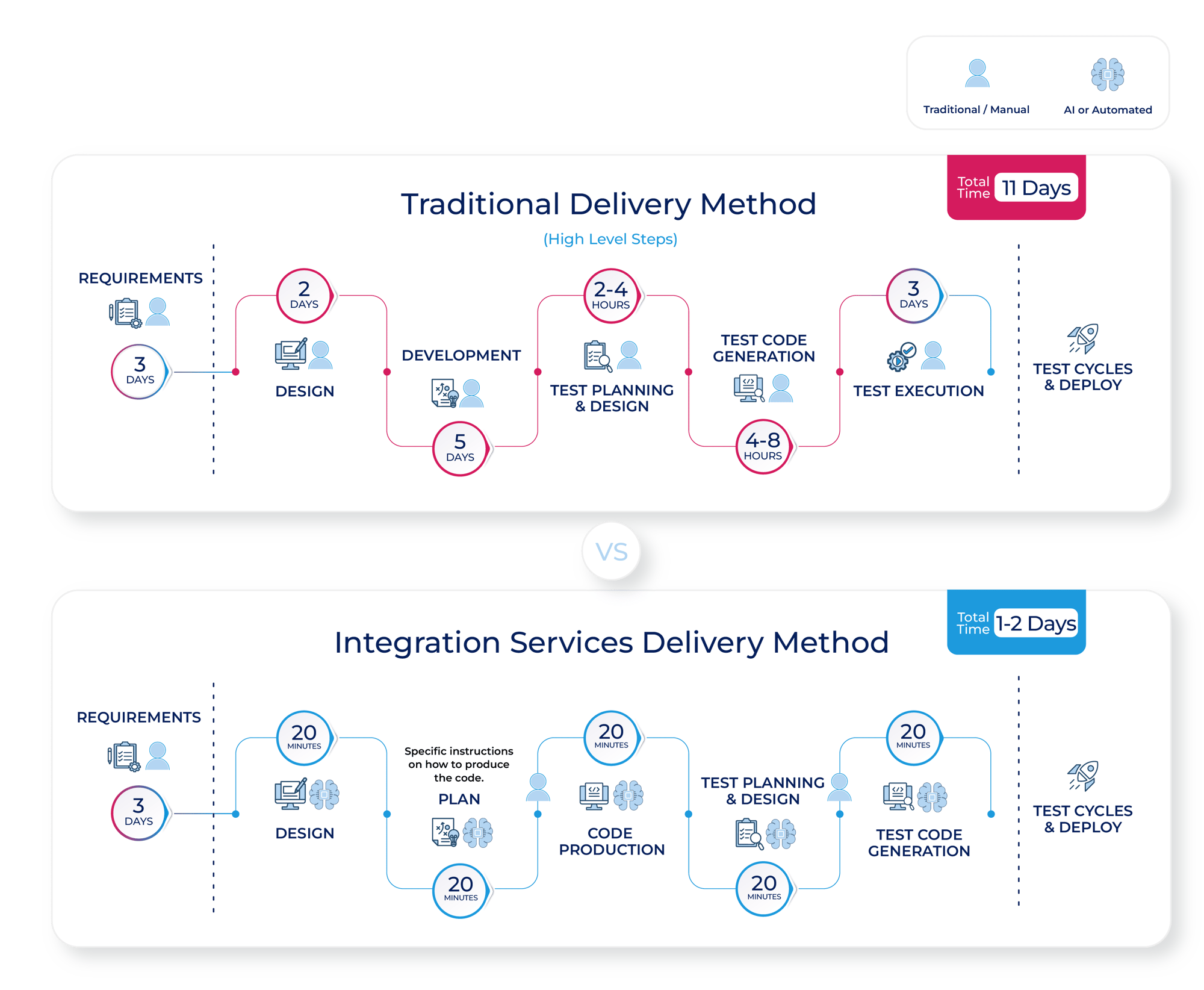
A team whose only job is your integrations. An engineer-owned pipeline, AI-boosted to handle the predictable work at speed so our architects can spend their time on the judgment calls.
That’s Agentic Integration Services (AIS): Pivotree’s integration practice, delivered as a fixed-fee, engineer-accountable product. We build the connections between your ecommerce, ERP, OMS, and PIM/MDM platforms. We ship them in days, not quarters. And we watch them in production after they go live, because go-live doesn’t mean done.
vs. traditional SI engagements
ship in days, not quarters
every integration we ship
Why we built AIS
The Agentic Integration Services model exists because the build alone isn’t enough, and the old way of doing it is slow and expensive. Integration is the most operationally exposed layer of the digital supply chain, and the place where the gap between “this worked in staging” and “this is working in production six months later” is widest. AIS closes that gap by keeping the same team accountable for your integrations from build through operation.
We call our approach RI + AI: real intelligence built up over decades in the business, amplified and made more efficient with AI. The AI integrations pipeline doesn’t ship code unsupervised. Engineers are accountable for every line that makes it into production—and every line that’s still running there five years later.
Who AIS is for:

Companies replatforming
And looking at a new integration surface that needs to work on day one and on day five hundred.
Organizations whose original SI
Has moved on, leaving an integration layer nobody's actively responsible for.
Internal engineering teams
Whose best people should be on the product roadmap instead of the integration backlog.
Operating models in active evolution
New channels, new fulfillment models, new business units—where the integration layer has to keep up.
Integration-as-a-Service FAQs
Most managed service contracts are help desks. They respond to tickets, escalate when they can’t fix things, and hand off to engineering for anything substantive. AIS Build + Operate is engineering. The same architects who built the integration are the ones operating it; the SLAs are about resolution against the integration’s actual job, not just response time on a ticket.
Subscription-based, scoped against the total number of integrations we’re building and operating. Pricing reflects the scope and complexity of the layer, not hourly billing. New integrations can be added at any time, and the subscription scales with the operation with volume discounts.
This is the most common reason customers come to us. We audit what’s there, take ownership of the code, and bring it back to production-grade. You don’t lose what you’ve already paid for; you just stop being the only one watching it.
A Free Integration Sprint runs in a day after requirements are gathered. A Build engagement varies by scope, but most projects deliver to staging in two to six weeks—about 45% faster than a traditional SI engagement of comparable size.
The code is yours. The integrations live in your infrastructure. We’re accountable for what we build, but nothing about AIS creates lock-in. If you ever wind down the engagement, you keep every line of code and every runbook we wrote.
We believe in RI + AI: real intelligence built up over decades in the business, amplified and made more efficient with AI. AI handles the predictable work—pipeline scaffolding, test generation, schema mapping—at speed. Our engineers handle the judgment calls—auth handling, business-logic edge cases, anything that touches money. The AI doesn’t ship code unsupervised. Engineers are accountable for every line that makes it into production.
Whatever you’re on, we’ve connected to it. We’re platform-agnostic by design. Your systems stay where they are and we make the connections between them work.
Let’s take the integration layer off your plate.
Tell us what’s running, what’s coming, and what you’re trying to keep your team free to work on instead. We’ll scope the program.